Cambodia has one of the most accessible long-term visa systems in Southeast Asia. This is genuinely true, and worth saying up front - because a lot of what’s written about Cambodian visas is either outdated, wrapped in unnecessary anxiety, or both.
The system is flexible. The paperwork is manageable. The grey areas are real but navigable if you understand what they are. And the parts that have changed recently - and things have changed, meaningfully, since 2024 - are worth knowing before you arrive.
This guide is for the person who is planning to move to Cambodia and wants to understand the visa system clearly before they commit. If you’re already here and things have drifted, there’s enough here to help you sort it out.
The E-class visa: what it is and why it matters
Cambodia has two main visa categories for foreign nationals: the Tourist visa (T-class) and the Ordinary visa (E-class). The names are slightly misleading. What matters is the practical difference.
The Tourist visa gets you 30 days. You can extend it once for another 30 days - 60 days total - and then you have to leave. Since November 2025, automatic extensions are gone; you must apply in person through the standard process. After 60 total days, the Tourist visa offers no further options. It cannot be converted to an E-class visa inside Cambodia. If you arrive on a Tourist visa and decide you want to stay longer, you have to exit the country, re-enter on an E-class, and start again.
The Ordinary visa (E-class) is a different animal entirely. It gives you the same initial 30 days, but that opening slot can be extended - in increments of 1, 3, 6, or 12 months - indefinitely. There is no legal maximum on how long you can stay in Cambodia on a series of E-class extensions. People have been here on consecutive EB renewals for decades.
Both visas cost nearly the same: Tourist is $30, E-class is $35. The $5 difference is, in practical terms, the most consequential $5 you’ll spend on the trip. Always get the E-class if there’s any chance you’ll want to stay longer.
How to get the E-class: on arrival at any of Cambodia’s international airports (Phnom Penh, Siem Reap, Sihanoukville), or in advance via the official e-visa portal at evisa.gov.kh ($35 plus a small processing fee). At the immigration counter, explicitly ask for the “Ordinary visa” - the default for many officers is Tourist. Once you have a Tourist stamp, you cannot change it without leaving.
Before you fly, you’ll also need to complete the Cambodia e-Arrival Card (CeA) within 7 days of your arrival date, at arrival.gov.kh. It’s free. Any website charging for it is a scam.
The E-class extensions: EB, ER, EG, ES
Once you’re in Cambodia on an E-class visa, you extend your stay by choosing a sub-category. The main four:
| Extension | Who it’s for | Duration options | Multiple entry? |
|---|---|---|---|
| EB (Business) | Employees, business owners, freelancers, remote workers, dependants | 1, 3, 6, or 12 months | 6 and 12-month only |
| ER (Retirement) | Retirees aged 55+, not working | 1, 3, 6, or 12 months | 6 and 12-month only |
| EG (General/Job-seeking) | Foreigners looking for work, not yet employed | 1, 3, or 6 months max | No |
| ES (Student) | Students enrolled at a registered Cambodian institution | 1, 3, 6, or 12 months | 6 and 12-month only |
For the vast majority of expats in Kampot and Cambodia generally, the relevant choice is between EB and ER. The EG extension is designed as a temporary bridge and can only be renewed once - it is not a long-term strategy.
The EB extension: who it’s for and what it costs
The EB is the standard long-term expat visa. It covers employees of Cambodian companies, business owners, freelancers, self-employed foreigners, and their non-working spouses and children. In practice, it covers almost everyone who isn’t retired.
Cost, all-in through an agent for a 12-month extension: $285–$300. This is the government fee (~$180) plus the agent’s markup ($100–$120). The agent fee is often negotiable. Most experienced expats use agents for visa extensions - the General Department of Immigration (GDI) in Phnom Penh is designed around bulk agent submissions, and going directly is technically possible but involves more time, more queuing, and the same government fees.
Processing time: 3–5 business days in normal circumstances. Longer around public holidays - Cambodia has many.
The 12-month EB extension gives you multiple entry, meaning you can leave and re-enter Cambodia without starting the extension process again. The 1 and 3-month extensions are single-entry only - leaving invalidates the extension.
Dependants: spouses and children of EB holders can apply for their own EB extension using the primary holder’s employment letter (with a note that the employer supports the dependent’s application) plus proof of relationship.
The paperwork: what you actually need
For a 12-month EB extension, your agent will ask for:
- Valid passport (at least 6 months remaining validity, at least one blank page)
- 2–3 passport-sized photos (4×6 cm, white background)
- A stamped employment letter - from your Cambodian employer, or self-written if you are self-employed and have a registered business with a company stamp
- A valid work permit (see the section below - this is now required)
- Proof of FPCS registration (see the section below - your landlord handles this)
Your agent will guide you through what format they need for each document and whether anything additional is required for your specific nationality. Some nationalities face slightly different requirements; ask explicitly when you first contact an agent.
One practical note on US dollars: Cambodia’s immigration system runs on USD. Bring clean, undamaged bills. Pre-2006 $100 notes are widely rejected. Immigration officers are strict about bill condition in a way that catches people off guard.
The work permit question
This is the part most guides either get wrong or leave out.
The work permit and the EB visa extension are two separate documents. The visa extension allows you to stay in Cambodia. The work permit, issued by the Ministry of Labour and Vocational Training (MLVT) via the FWCMS online portal (fwcms.mlvt.gov.kh), authorises you to work.
Since 2024, enforcement has tightened significantly. The FWCMS portal now shares data with immigration. EB visa renewals for 6 and 12 months are being denied when the work permit is missing or expired. This is no longer a theoretical requirement - it is being applied in practice.
If you are employed by a Cambodian company: your employer handles the Foreign Employee Quota (FEQ) application and should manage your work permit through FWCMS. You provide the documents they ask for. If your employer isn’t familiar with the process, that’s a red flag about how seriously they take compliance.
If you are self-employed or run your own business: you need to register a sole proprietorship (a “Patent Tax” registration, approximately $125), then apply for your own work permit through the self-employed channel on FWCMS. Government fee approximately $130. Total cost for registration plus permit: roughly $255. Add your 12-month EB extension ($285–$300) and your annual visa and compliance cost is in the range of $400–$600.
Work permits run on a calendar year (January 1 to December 31) and must be renewed by March 31 each year. If you miss the deadline, you face potential fines and complications at your next EB renewal.
The penalty for working without a work permit is approximately $12,600 (KHR 50.4 million) for self-employed foreigners. For employers, the fine per undocumented worker is approximately $3,150. These numbers are real and enforcement has increased. Do not skip this.
The digital nomad grey area - plainly stated
Cambodia does not have a digital nomad visa. It has made no announcements suggesting one is planned.
If you work remotely for clients or an employer outside Cambodia while living here - whether that’s freelance work, a remote salary, or running an online business - you are legally defined as self-employed under Cambodian law. The MLVT’s rules state that self-employed foreigners must have a work permit.
The historical reality is that many remote workers in Cambodia have operated without one for years, on the basis that their income comes from outside Cambodia and they are unlikely to be inspected. This is still widely practised. The risk level has increased, however. The FWCMS-LACMS database integration means immigration can check your permit status at the point of any EB renewal. People without permits are finding renewals denied.
The practical picture in 2026: if you are staying long-term and want a clean situation - and if you plan to stay indefinitely - registering a sole proprietorship and getting a work permit is the route that removes the compliance risk entirely. The all-in annual cost of around $130 for the permit plus roughly $125 for the sole proprietorship registration is not prohibitive.
If you are only staying 3–6 months and are unlikely to face a renewal cycle, the risk is lower. Use your judgment and be aware that it is a genuine legal grey area, not an imaginary one.
The ER retirement extension: briefly
The retirement extension (ER) is for foreigners aged 55 and over who are not working. It is genuinely straightforward by regional standards: Cambodia imposes no minimum income requirement and no mandatory bank deposit. You need proof of retirement status from your home country (a pension statement, Social Security documentation, or similar) and to be at least 55 years old.
Cost through an agent for a 12-month extension: approximately $275–$300, renewable indefinitely. ER holders do not need a work permit, since they cannot legally work. If you want to work after arriving on an ER, you need to switch to EB.
Some younger expats (under 55) have reportedly obtained ER extensions by demonstrating significant savings or passive income. Requirements for under-55s are not publicly defined and vary by agent. If you are under 55 and not working, ER is not a reliable strategy - the EB with self-employment registration is the more predictable route.
The FPCS: what your landlord needs to do
FPCS stands for Foreigners Presence in Cambodia System - an online registration system managed by the General Department of Immigration. Your landlord or property manager is legally required to register you in the system within 24 hours of your moving in.
This is not optional, and it is not the foreigner’s responsibility to do - it is the landlord’s. The practical consequence for you: if your landlord hasn’t registered you in FPCS, your EB extension application will be rejected.
When you arrive at any new address, confirm with your landlord that they have FPCS and have registered you. Most established guesthouses, apartments, and rental properties in Kampot are familiar with the requirement. Smaller or less formal landlords occasionally aren’t - in which case, your visa agent can often register you through their own FPCS account as a workaround.
What changed in 2025 and 2026
A few things have shifted recently that older guides don’t reflect:
E-class entry visa fee reduced to $35 (from $42) on 1 January 2025. The tourist visa is $30.
Automatic tourist visa extensions ended in November 2025. The pandemic-era practice of granting extensions almost automatically is definitively over. Extensions require explicit in-person application.
Work permit enforcement tightened from 2024 onwards. The FWCMS-GDI data integration means EB renewals are now being denied without valid work permits in a way that was previously only nominally enforced.
Cambodia e-Arrival Card (CeA) became mandatory for all air arrivals from January 2025, replacing paper forms. Complete it at arrival.gov.kh within 7 days of travel. It is free.
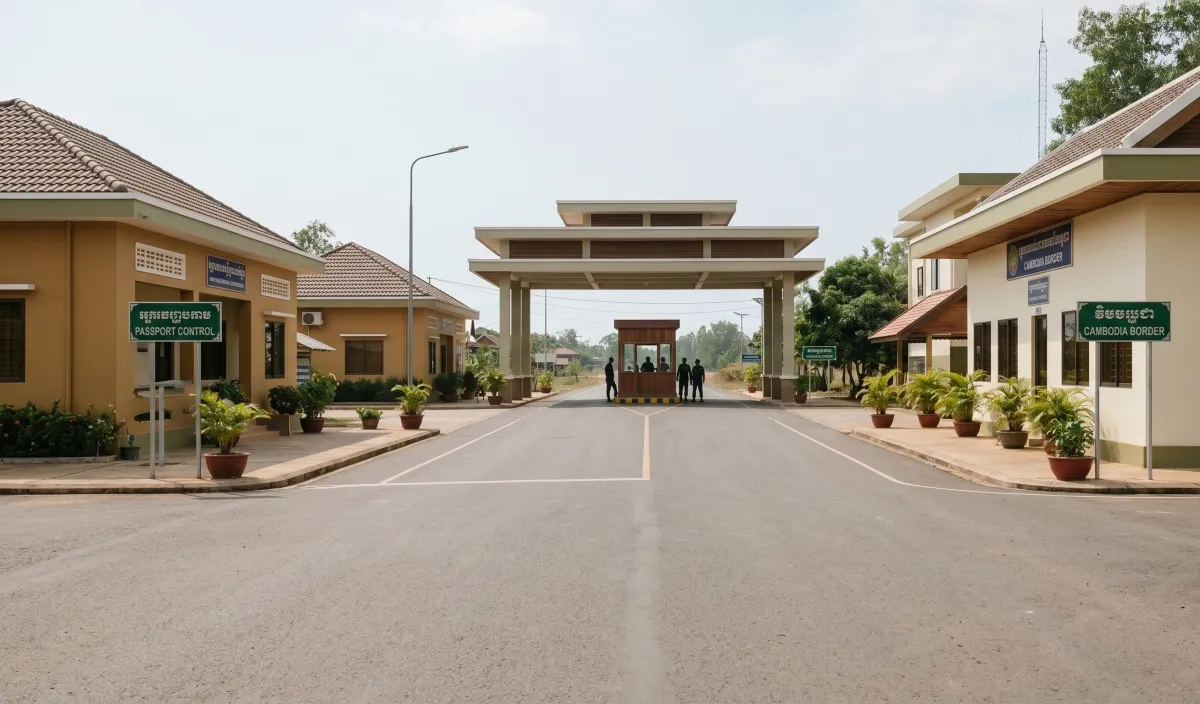
Thailand land borders remain closed. All land crossings between Cambodia and Thailand have been closed since June 2025 following armed border conflict. A ceasefire came into effect in late December 2025, but as of May 2026, all border crossings remain shut with no confirmed reopening date. The Thai navy stated in April 2026 that there is no policy to reopen crossings, and security assessments suggest the border is unlikely to reopen in 2026. Travel between Cambodia and Thailand is currently possible only by air. Visa runs to Thailand - previously a common method of resetting a Tourist visa - are only possible by flying.
Vietnam borders remain open. The Prek Chak / Ha Tien crossing (the route closest to Kampot, used to access Phu Quoc and the Mekong Delta) accepts Visa on Arrival only, not e-Visa. The Bavet / Moc Bai crossing (the main Phnom Penh–Ho Chi Minh City route) accepts both e-Visa and Visa on Arrival.
The practical sequence: how most people actually do this
-
Before flying: apply for the E-class ordinary visa via evisa.gov.kh ($35 + processing), or obtain it on arrival at the airport. Complete the CeA e-arrival card. Bring clean USD banknotes.
-
On arrival: tell immigration you want the “Ordinary visa” (E-class). Not Tourist.
-
First week: find accommodation. Confirm with your landlord that they will register you on FPCS. Most established rentals in Kampot will know the process.
-
Before your initial 30 days expire: contact a visa agent (ask at your guesthouse or in the Kampot expat Facebook groups for current recommendations - agents change, quality varies, and local word-of-mouth is the most reliable guide). Submit your EB extension application with your passport, photos, and employment letter. Start the sole proprietorship registration if you are self-employed.
-
Once settled: apply for your work permit via FWCMS if you’re working in any capacity. This should be done within 90 days of first entry.
-
Each year: renew your EB extension before it expires; renew your work permit by March 31.
The system is genuinely manageable. The things that trip people up are almost always the same: arriving on a Tourist visa without realising the limitation, missing the FPCS registration because the landlord didn’t mention it, or letting the work permit slide because it felt like a technicality. It isn’t. Treat it as a fixed annual cost of doing things properly, because the fine for not doing so is real.
Visa rules in Cambodia change without formal announcement. The information in this article reflects the situation as of May 2026, sourced from Cambodia Expats Online, Move to Cambodia, and official MLVT and GDI sources. Always verify current requirements with a Kampot or Phnom Penh-based visa agent before your first renewal.