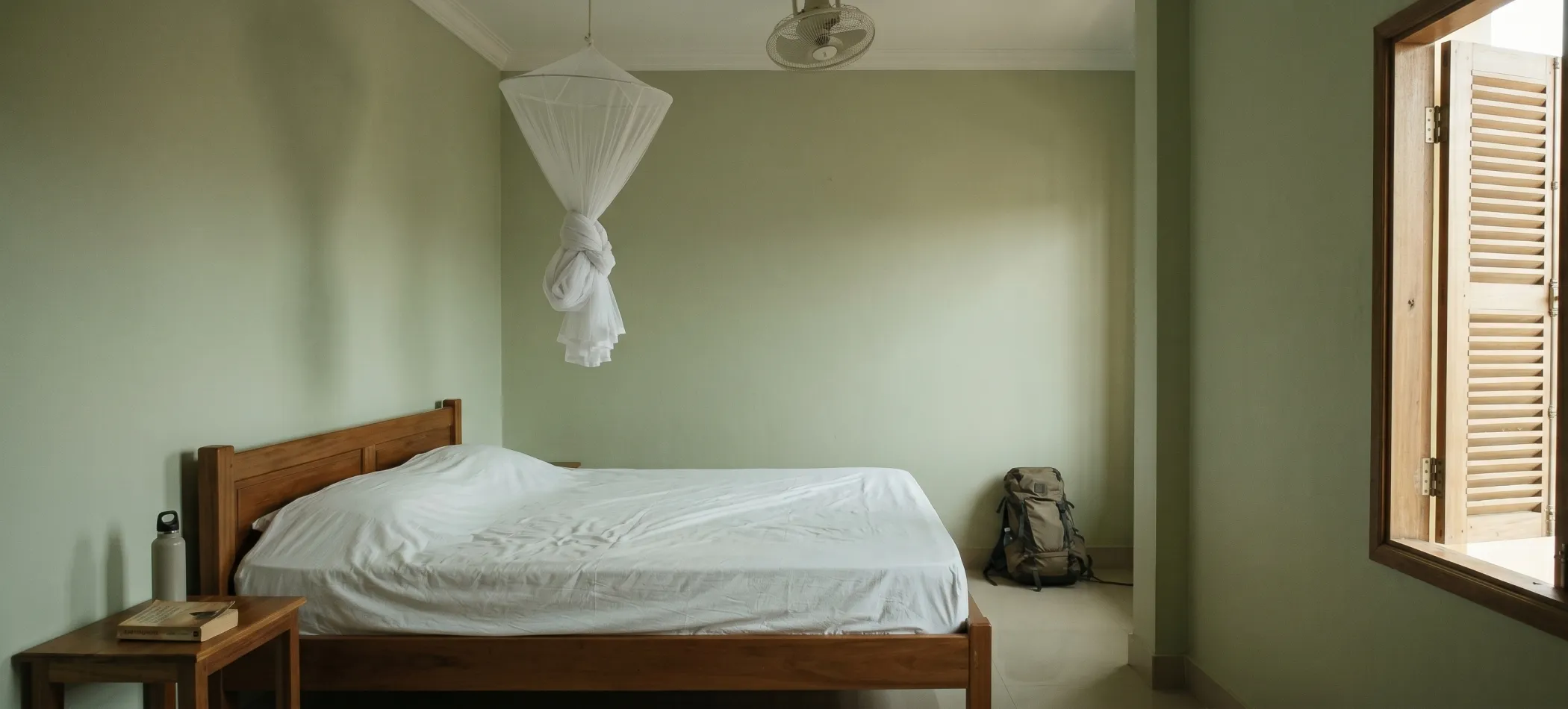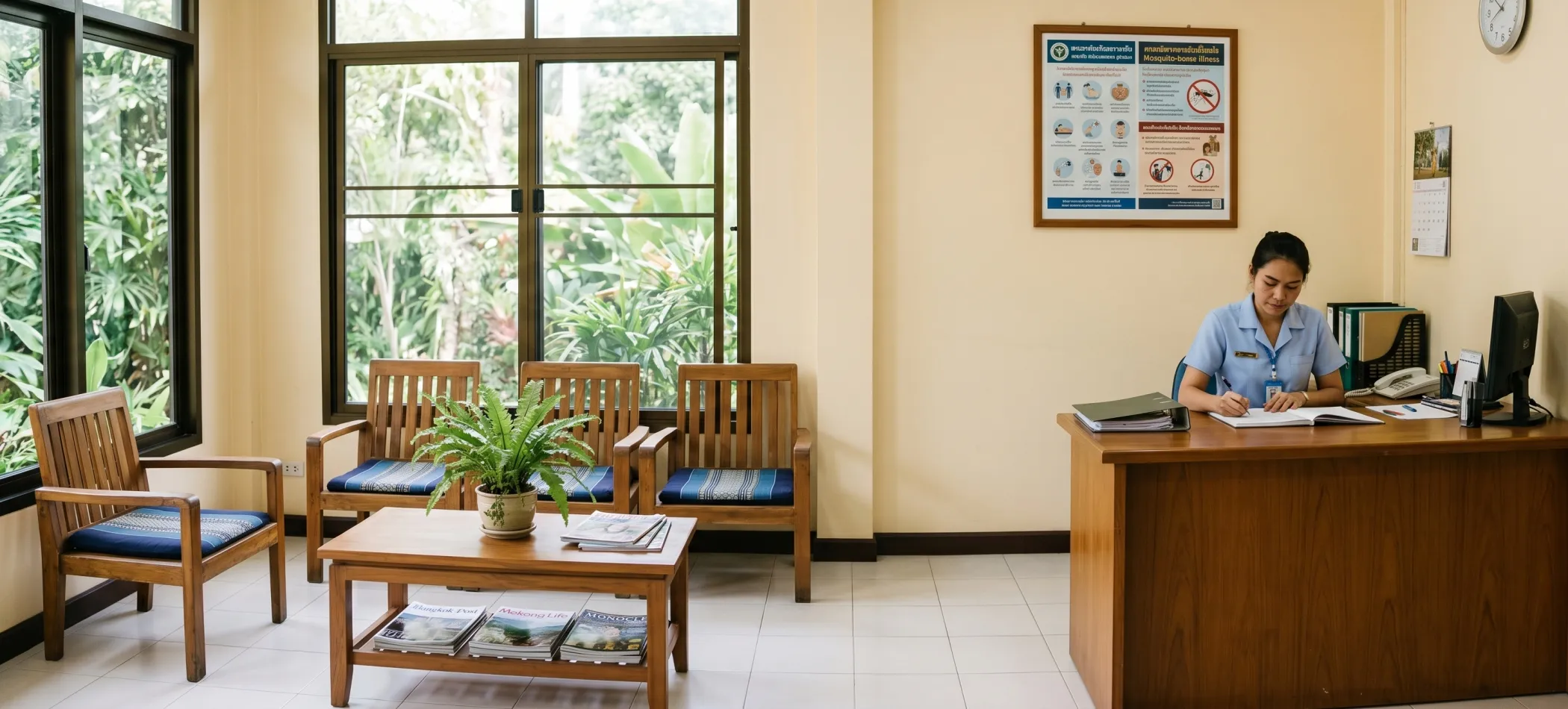
Kampot is not a dangerous place to live. That’s the first thing to say, because the question people are really asking when they ask about healthcare here is: “Will I be okay if something goes wrong?”
The honest answer is: probably yes, for the vast majority of things that go wrong with healthy adults living ordinary lives. Infections, minor injuries, dental issues, the occasional fever that needs a blood test - all of this is manageable in Kampot. What it isn’t is comprehensive. There are no specialists here. There is no MRI. For anything that requires imaging beyond an X-ray, surgery beyond the routine, or a second opinion from a cardiologist, you are looking at a three-hour drive to Phnom Penh.
That gap is real, and worth understanding before you move. It is also the gap most long-term residents here learn to live with quite comfortably, once they understand what it is and have the right insurance in place.
What Kampot actually has
The town has two hospital-level facilities and a handful of clinics and pharmacies. They are not equal.
Sonja Kill Memorial Hospital (SKMH) is the one you want to know about. It is a non-profit charity hospital located 6-7 kilometres west of town on National Road 3, on the road toward Bokor Mountain - about a 15-minute scooter ride from the old quarter. It was established by a group of German foundations and Hope Worldwide, and its mission is to provide quality care regardless of ability to pay: poor Cambodian families are treated free, while those who can contribute pay a fee. Foreigners pay a sliding scale rate; a consultation with a Western doctor runs around $20.
The facility is genuinely good by regional standards. It has an outpatient department, inpatient ward, maternity unit, surgical department, emergency room (24/7), radiology including X-ray, laboratory, and a growing physiotherapy service. The doctor roster includes both international and Cambodian staff trained overseas, including surgeons, internal medicine physicians, OB/GYN, paediatrics, and a family medicine consultant. It handles general medicine, surgical cases, maternity care, and paediatrics well. It is also one of very few post-graduate medical training centres in Cambodia outside Phnom Penh.
The practical limitations: outpatient hours are Monday to Friday, 8am to 5pm. For non-emergencies at weekends, you can still be seen in the emergency department, but wait times will be longer. There is no MRI. There are no cardiologists on permanent staff. Complex imaging and specialist care are not available, and SKMH will refer patients to Phnom Penh when cases exceed their capacity.
Contact: 077 666 752 (general) / 078 265 782 (emergency only, 24/7).
Kampot Referral Hospital is the public hospital in town. It is there if you need it. Most experienced expats advise against using it for anything beyond an absolute emergency when nothing else is accessible. Equipment is limited, staffing is variable, and the standard of care is well below what SKMH offers. There is an eye clinic attached that has a reasonable reputation among expats for minor ophthalmology matters, but for general care, go to SKMH.
Private clinics: there are several small private clinics in town that handle minor consultations and basic treatment. Quality varies. SKMH is the more reliable choice for anything that needs proper diagnosis; clinics are mainly useful for a quick consultation, prescription refill, or blood pressure check.
Dental: better than you think
This is consistently the pleasant surprise for people moving to Kampot. Dental care in Cambodia is good, accessible, and cheap by almost any benchmark.
Piseth Dental Clinic near the durian roundabout is the expat favourite, consistently recommended across forums and word-of-mouth for years. Dr. Piseth does inexpensive cleanings and treatments, charges around $10 for a clean, and accepts walk-ins. His brother has a second Piseth Dental Clinic near the new market with a similarly good reputation.
Most routine dental work - fillings, extractions, crowns - costs a fraction of what it would in Europe, Australia, or North America, and the quality at the better clinics is solid. Many expats end up doing more dental work in Cambodia than they would at home simply because the price barrier is removed.
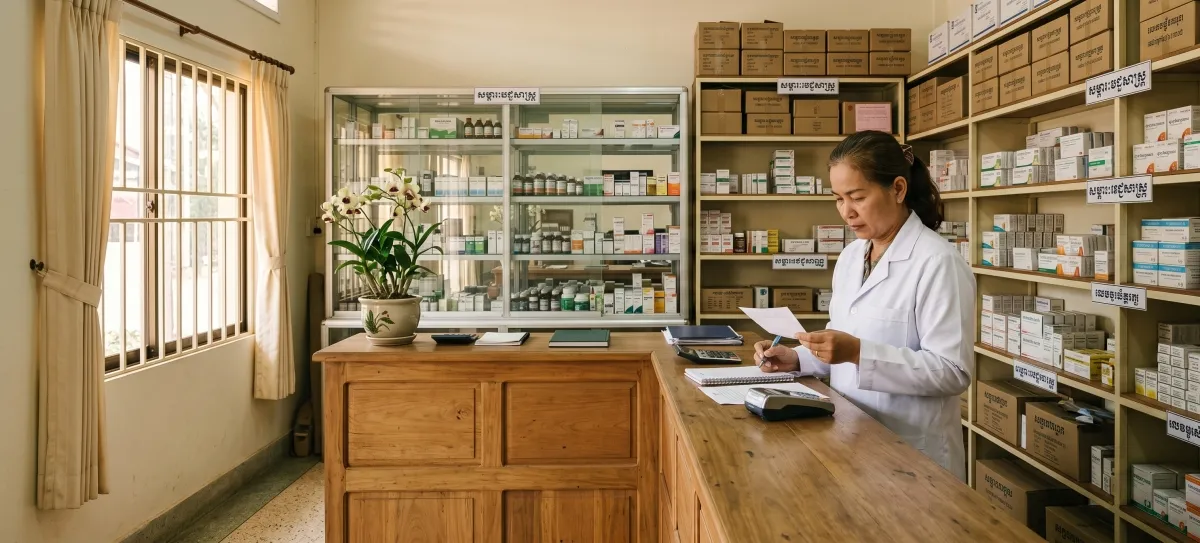
Pharmacies: the informal healthcare system
Cambodia’s pharmacies are well-stocked and function as a first port of call for a wide range of things that would require a doctor’s prescription elsewhere. Antibiotics, antiparasitic medications, antifungals, antihistamines, and basic prescription medication are generally available over the counter at low prices.
This is genuinely useful. The usual caveats about self-medication apply - don’t treat a serious infection without a proper diagnosis - but for travellers’ diarrhoea, skin conditions, mild infections, and the kind of ailments that experienced Southeast Asia residents learn to manage, the pharmacy is often the correct first step.
In Kampot, U-Care Pharmacy on Street Ekareach is the branch of a Cambodia-wide chain; prices are somewhat higher than local pharmacies but they stock a wider range of international brands and are reliable on medication authenticity. NutriPharma on Street 701 in Kampong Bay Tbong and Chamrouen Chanlida on Street 735 are both well-stocked local alternatives, both cheaper, and both open considerably later - see below. Davy Pharmacy, by the Kampong Bay bridge, is the one most often recommended for English-speaking staff.
One thing worth knowing: carry a supply of any critical or unusual medications when you arrive. Specific brand-name drugs, psychiatric medications, and less common treatments may not be stocked consistently in Kampot. Know the generic name of any medication you depend on so a pharmacist can identify the local equivalent.
After hours: what is actually open
There is no 24-hour pharmacy in Kampot. This is the thing worth knowing before you need to know it, because the town closes earlier than people expect and the answer at eleven at night is not a pharmacy at all.
The two reliable late options both close at 10pm:
- Chamrouen Chanlida, Street 735 - 8am to 10pm, seven days. 081 478 686.
- NutriPharma, Street 701 in Kampong Bay Tbong - 7am to 10pm, seven days, opening half an hour later on Sundays. 015 746 789.
U-Care on Street Ekareach runs 9am to 9pm daily but closes for an hour at noon, which catches people out. Davy Pharmacy by the Kampong Bay bridge is 8am to 8pm.
A few listings around town advertise later closing times than these. Treat them with suspicion - the ones we could corroborate are above, and at least one widely-listed 10.30pm closing time is contradicted by customers who turned up and found the shutters down.
After 10pm, the answer is Sonja Kill. The emergency department at SKMH runs 24 hours, seven days, including public holidays, and dispenses through the hospital’s own pharmacy. The number is 078 265 782. This is a genuine emergency route rather than a late-night chemist - you are being seen, not served over a counter - so it is the right call for a fever that has turned worrying at midnight, and the wrong one for having run out of antihistamines.
Note the distinction that catches people out: SKMH’s emergency department is 24/7, but its outpatient department is weekdays only, 8am to 5pm. Turning up on a Sunday afternoon with something non-urgent means the emergency department or nothing.
The practical version of all this: if you take anything regularly, do not let yourself get down to the last two days of it. Kampot is not a town where you can solve that at 9pm on a Sunday.
When you need to go to Phnom Penh
The general rule: anything that requires specialist input, imaging beyond a basic X-ray, complex surgery, or significant diagnostic workup means Phnom Penh.
The drive is 148km on National Road 3 - around three hours, longer if the traffic out of the capital is bad. A Giant Ibis or Virak Buntham bus is scheduled at four. Most people with insurance arrange private transport for anything genuinely urgent.
In Phnom Penh, the clear first choice for expats is Royal Phnom Penh Hospital on Russian Confederation Boulevard. It is affiliated with Bangkok Dusit Medical Services, is the only JCI-accredited hospital in Cambodia, has English-speaking staff, full specialist coverage, 24/7 emergency and ambulance service, MRI, CT, ICU, and direct billing with most major international insurers. It is not cheap by Cambodian standards, but it is the facility that most closely matches what expats from Europe, Australia, and the Gulf expect from a hospital. Emergency number: +855 23 991 222.
Sunrise Japan Hospital is a newer option, well-regarded for its diagnostics and multilingual staff. Sen Sok International University Hospital is Singaporean-managed and offers good specialist coverage at somewhat lower prices than Royal Phnom Penh. International SOS Clinic and Naga Clinic (French-run) are good GP and general consultation options for when you don’t need a full hospital.
For genuinely complex cases - serious cardiac events, major trauma, anything requiring specialist surgery or treatment not available in Cambodia - the standard practice for expats with proper insurance is medical evacuation to Bumrungrad International Hospital in Bangkok (about a one-hour flight). Without insurance, an air ambulance costs $15,000-$50,000. With the right coverage, the insurer arranges it. This is why evacuation coverage is not a nice-to-have.

Health insurance: what most residents carry
Carrying international health insurance with medical evacuation coverage is as close to a non-negotiable as anything in this guide. It is the line item people most regret skipping, and in Cambodia specifically, evacuation coverage is what you’re really buying - because the scenario where you need to be flown to Bangkok for treatment that doesn’t exist here is more plausible than it sounds.
Cost benchmarks for 2026:
- Solo adult under 50: $80-$150/month for a comprehensive plan with evacuation
- Solo adult 50-65: $120-$220/month
- Family with two children: $250-$400/month
Commonly recommended insurers among Cambodia expats include Cigna Global, BUPA International, AXA, Pacific Cross, and Luma Health (which is specifically Cambodia-focused and has direct billing arrangements with Royal Phnom Penh Hospital). Any policy for Cambodia should explicitly cover medical evacuation to Bangkok or Singapore - not just in-country treatment.
Pre-existing conditions are typically excluded for the first 12-24 months; disclose everything accurately when you apply. Dental riders add $15-30/month, but given how inexpensive dental care is in Kampot out-of-pocket, many residents skip the dental add-on and pay directly.
One practical note: FORTE Insurance is Cambodia’s main domestic insurer and is widely accepted at local facilities. It’s significantly cheaper than international plans but provides minimal coverage for evacuation and specialist care outside Cambodia. It is useful as a supplement for day-to-day coverage in Kampot; it is not a substitute for international insurance.
Mental health: the honest picture
Mental health services are one of the genuine gaps in Kampot’s healthcare landscape. There is nothing locally. The nearest qualified English-speaking mental health professionals are in Phnom Penh.
In Phnom Penh, the main options expats use are the Bamboo Centre (an international team of qualified psychotherapists, offering individual, couples, and family therapy in English and French), Sombok Psychology (Cambodian and expat psychologists, evidence-based practice), and TPO Cambodia (Transcultural Psycho-Social Organization, which offers outpatient psychiatric and psychological treatment). Most practitioners in Phnom Penh also offer online sessions, which is how many Kampot residents access these services.
If you have existing mental health care needs - regular therapy, psychiatric medication management, or anything requiring ongoing clinical support - factor in the cost and logistics of accessing Phnom Penh services, or find a provider who offers remote sessions from the start.
This is not a reason not to move to Kampot. It is a practical reality worth knowing about before you do.
In a medical emergency
The emergency number for SKMH is 078 265 782 (24 hours). This is the facility to call first for any urgent medical situation in or near Kampot.
For the national ambulance number (variable response times), dial 119. Do not rely on this for anything time-sensitive outside major cities.
If the situation is serious enough to require Phnom Penh, the most reliable option is to arrange private transport directly or call Royal Phnom Penh Hospital’s emergency line (+855 23 991 222), which can coordinate ambulance pickup from Kampot. Your insurance provider’s emergency line should also be in your phone before you need it.
A few practical things worth having before they become urgent: the address of SKMH in Khmer to show a tuk-tuk driver, the emergency numbers saved in your phone, and a clear sense of what your insurance covers and how to activate it. None of this is complicated to arrange. Most long-term residents set it up in their first week and then forget about it for years.
The summary, plainly: Kampot is a fine place to live for healthy adults who understand what the healthcare system here can and cannot do. SKMH is genuinely good for what it handles. Dental is better than expected. Pharmacies cover more ground than they would at home. The gaps are specialist care, complex diagnostics, and mental health services - all of which require Phnom Penh, and all of which are reasons to have proper insurance in place before you need them.
Most people who have been here a few years find that they go years without needing more than a dentist and a pharmacy. Some find themselves needing Phnom Penh once or twice. A small number need Bangkok. The insurance is there for that small number, and it costs less than a single emergency flight without it.