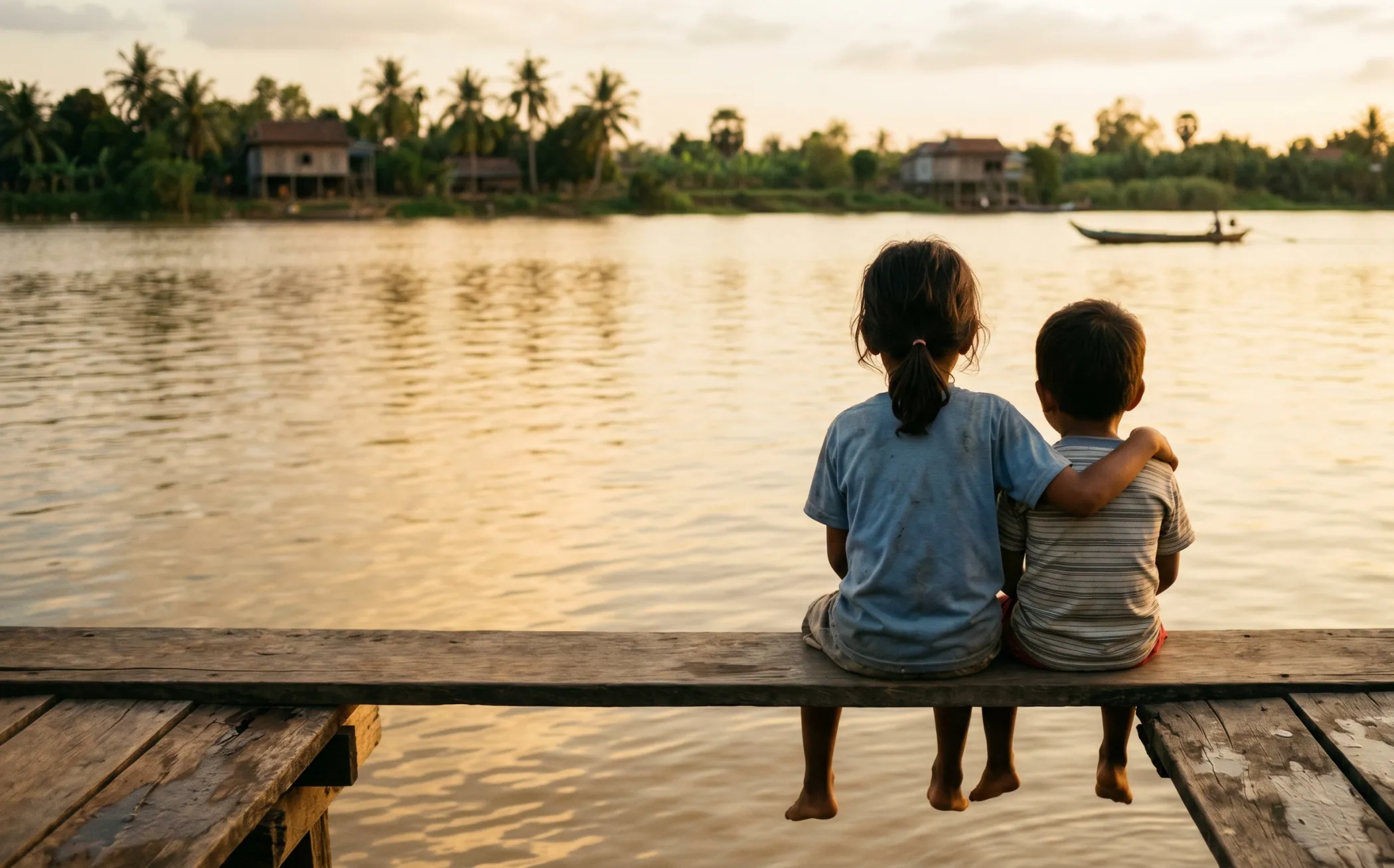
Kampot is not designed for children in the way that some family travel destinations are designed for children. There is no water park. There are no organised children’s clubs. The activity infrastructure that fills out a family holiday in Bali or Phuket - the kids’ cooking classes, the cultural performance packages, the resort animation programme - is largely absent.
What there is instead is the outdoors, in quantity: a river to kayak, farms to walk through, caves to explore, a countryside that can be covered by tuk-tuk in a day and remembered for longer. And for families choosing to live here rather than visit, there is a small but genuine expat parent community, two English-medium schools for primary-age children, and the particular quality of a childhood that unfolds mostly outside.
This guide serves two different types of family reader. The first is visiting for a week and wants to know what to do with young children. The second is weighing a longer move and needs the honest picture on schools, community, and the things that require planning. Both are covered here, in that order.
Visiting with children: the week-in-Kampot family guide
Kampot is an easy place to bring children, provided you are not expecting a resort-style structure. The town is quiet, the traffic is manageable by Southeast Asian standards, the food is child-accessible even for fussy eaters, and the activities are mostly outdoor and active in ways that children tend to enjoy more than their parents expect.
The countryside tuk-tuk tour
The single most recommended family activity in Kampot, consistently, by every family who has done it: a full-day tuk-tuk tour of the surrounding countryside. A hired tuk-tuk and driver - $20-30 for the day, negotiated at your guesthouse - covers the pepper farms, the cave temple at Phnom Chhngok, the salt fields (in season), and the road between them, which is itself a landscape of rice paddies, fishing villages, and mountains that children experience from a moving open vehicle at exactly the right pace.
La Plantation pepper farm is particularly good for children. The free guided tour is unhurried and hands-on - children can pick peppercorns from the vine, taste the different varieties, and understand where the thing on the table at home actually comes from. The farm has a restaurant for lunch and enough space for children to run around between the vines. Allow two to three hours including the drive.
Phnom Chhngok cave temple is dark, slightly mysterious, full of stalactites, and has 203 steps - all of which tends to engage children considerably more than it engages adults. The local child guides who offer their services at the base are a natural point of contact and often make better tour guides for visiting children than any adult alternative.
The salt fields southeast of town are worth including if you are visiting between December and April, when active production is underway and the shimmering white salt flats create one of the more visually striking landscapes in the region. In the wet season they are empty; save that day for something else.
The river
Kayaking the Green Cathedral loop is manageable for children from about age six or seven, depending on the child. The loop is calm and shaded, takes one to two hours at a gentle pace, and the animal life - dragonflies, kingfishers, waterfowl - gives children something specific to look for throughout. Life jackets are available; ask for them when you hire. Hire at Champa Lodge or Bopha Prey Riverside on the river road north of town, $5/hour.
A sunset river cruise from the town centre is the lower-energy alternative for smaller children or families who want something less active - most operators run evening cruises along the Praek Tuek Chhu for $5-10 per person, lasting an hour to ninety minutes. The light on the mountains as the sun goes down is the reason to go.
The Kep day trip
Kep works well as a family day trip from Kampot - thirty kilometres, forty minutes by tuk-tuk. The crab market at the waterfront is child-friendly in the chaotic-market-experience sense. The Kep Butterfly Centre, a short walk from the main beach, is a small but genuinely engaging stop: live butterflies in a netted garden, documented species, and a 45-minute experience that lands well for children who have any interest in insects or natural history.
The Kep National Park trail - 8km, shaded, with views from the ridge - is manageable for older children (8+) in the morning before the heat builds. Younger children and the beach section at Kep are better kept for the afternoon when the trail is less pleasant.
Eating with children
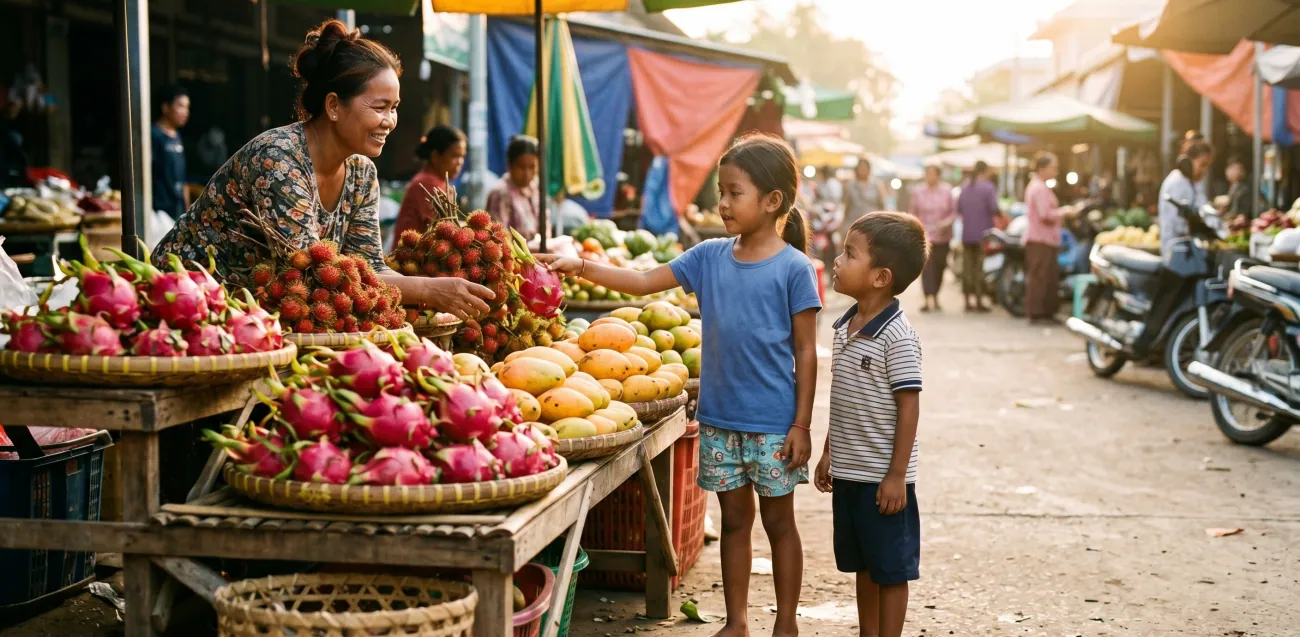
Kampot is not difficult for children to eat in. Epic Arts Café - the NGO-run café in the old quarter - is consistently welcoming to families: the menu is broad, the ordering-by-paper-slip system is low-pressure, and the food reliably good. Most riverside restaurants are casual enough that children’s noise and movement is unremarkable rather than disruptive. The market stalls offer an introduction to Khmer food that children often engage with more enthusiastically than adults expect - the pointing-and-receiving mechanic of ordering from a stall without a shared language turns out to be genuinely fun at age seven.
Western food is accessible enough - pasta, pizza, burgers - at the expat-facing restaurants in the old quarter, for nights when everyone is tired and the most important thing is that the children eat without negotiation.
Where to stay with children
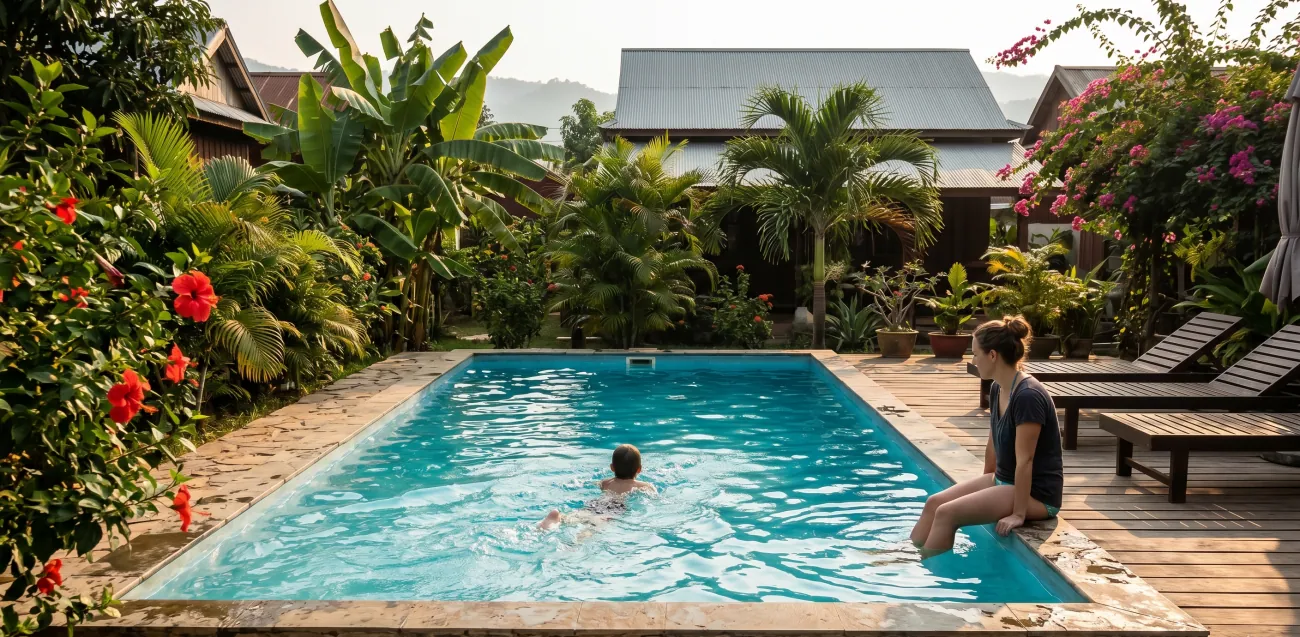
A guesthouse with a pool is the most practical choice for families visiting with children under ten, because the pool resolves the afternoon question on the hot days and gives children something to do during the adult rest hour. Komsan Kampot Resort is the most consistently recommended family property - river access, multiple pool areas, kayaking, and the kind of organised-space character that makes it feel like the accommodation is part of the holiday rather than just a bed.
If you want to be closer to town, properties in the old quarter with their own pools - Hotel Old Cinema being the most notable - combine walkable access to restaurants and the market with enough pool infrastructure to manage children who are done with sightseeing.
Living here with children: the longer picture
Moving to Kampot as a family requires more upfront research than moving as a solo adult or a couple, because the school question and the community question are both real and both worth understanding before you commit.
Schooling: the full honest breakdown
Peppercorns School is the main international option in Kampot itself. It is a parent-founded, community-run school on the Red Road, 800 metres past the new bridge, offering early childhood and primary education for children aged 2 to 11. The curriculum combines UK and Australian frameworks through play-based and thematic learning, with small class sizes (10-16 students) and qualified international teachers. Contact: 066 280 045, facebook.com/peppercornshomeschool.
Parents who have had children at Peppercorns are consistently enthusiastic about what it offers: the small classes produce a genuinely individual attention to each child, the outdoor-integrated approach suits children who learn through doing, and the community around the school creates a social infrastructure for expat families that is one of the main reasons people end up staying in Kampot longer than they planned.
The constraint: Peppercorns reaches to around age 11, Year 5 in the UK system. What happens next is the question every family at Peppercorns eventually faces.
Kep International School is thirty minutes from Kampot and runs a bus service for Kampot families. It follows an international curriculum in English, with Khmer and French instruction alongside, and takes students from multiple countries without requiring prior Khmer proficiency. The school has been building its reputation steadily and now hosts students from the US, Europe, and Asia. Fees are comparable to Peppercorns. Contact: 036 652 3777, kepinternationalschool.com.
Online schooling is how most Kampot expat families handle secondary education. K12, Connections Academy, and Wolsey Hall Oxford (UK-based, Cambridge curriculum) are the most commonly used platforms. Costs range from $1,500 to $4,000 per year depending on the programme. Cambodia imposes no legal restrictions on homeschooling for foreign families, and tutors for specific subjects are available from Kampot’s expat community at $10-25 per hour. The approach requires parental involvement and a degree of structure that works well for some families and poorly for others - it is worth being honest with yourself about which type you are before you rely on it.
Phnom Penh boarding arrangements: some families with older children split the week between Kampot and Phnom Penh, with children attending school in the capital during the week and returning to Kampot for weekends. This works logistically - the bus journey is 3.5 hours each way - and several Phnom Penh guesthouses specifically accommodate expat children on weekly arrangements. It is a commitment, and the family that makes it work tends to be one where the school week separation is accepted as the cost of the Kampot life rather than experienced as a sacrifice.
The honest summary on schools: Kampot works well for families with children under 11. After that, the options require either flexibility, online schooling confidence, or a logistical arrangement that most families find adds friction. This is a genuine constraint and worth factoring into a decision about when to move rather than whether to move.
The expat parent community
The expat parent community in Kampot is small and connected in ways that larger communities often aren’t. Parents at Peppercorns know each other well. There are playdates, shared transport to Kep International, informal pools of knowledge about doctors, activities, and the particular logistics of raising children somewhere that doesn’t have a ready-made infrastructure for it.
The main entry points: the Peppercorns Facebook page, the Kampot Kep Expats & Locals Facebook group, and simply arriving and talking to people at Epic Arts Café or at the school gates. The community is small enough that one warm introduction opens most of the rest of it within a few weeks.
The absence of a ready-made structured social life for children - no Saturday football league, no swimming club, no children’s drama group at the scale you might find in a larger expat hub - is real. Children in Kampot tend to develop the capacity for unstructured outdoor play and mixed-age socialising in ways that children in more structured environments sometimes don’t. Whether this is an advantage or a limitation depends on the child.
What’s harder than expected
The heat. Children who are very young or who are not accustomed to tropical temperatures require more management in Kampot than older, acclimatised children. The afternoon heat between March and May is the hardest window; a pool and air-conditioned indoor time become practical necessities rather than luxuries.
Healthcare access for children. Routine paediatric care is available at SKMH (Sonja Kill Memorial Hospital, 6km west of town). For anything beyond routine - a specialist assessment, an unexplained illness, anything that requires imaging - you are looking at a three-hour drive to Phnom Penh. Families with young children should carry comprehensive health insurance with paediatric coverage and evacuation to Bangkok, and should establish a relationship with a Phnom Penh paediatrician early.
The secondary school gap. Already addressed above. It is worth repeating because it is the thing families most often wish they had thought through earlier.
What’s better than expected
The freedom children get in Kampot is something most expat parents cite as the defining advantage of raising children here. The town is small enough to be safe in a low-traffic, known-faces way. Children from Peppercorns and the wider expat community develop a particular confidence and adaptability - moving between Khmer and English, navigating mixed-age groups, entertaining themselves outdoors - that their parents consistently describe as one of the best things the Kampot experience gave them.
The cost of a childhood here, compared to what the same family would spend in London or Sydney or Dubai, is dramatically lower: school fees, food, activities, and the general overhead of child-raising are a fraction of what they cost in high-income countries. This allows some families to have a parent home full-time in a way that wouldn’t be economically possible elsewhere, which changes what family life in Kampot looks like.
And the children tend to be happy here. Not because Kampot is a purpose-built children’s destination - it isn’t - but because the pace, the outdoor access, the river, the farms, the community of other expat children, and the particular warmth of Cambodian attitudes toward children combine into something that children find, more often than not, genuinely good to grow up in.
The families who do best in Kampot are the ones who arrive with realistic expectations about what isn’t here, and an openness to what is. The water park isn’t here. The Saturday sports league isn’t here. What is here is a river, a countryside, a small school where someone knows your child’s name, and more time together than most families get anywhere else.
For some families, at some points in their lives, that turns out to be exactly enough.